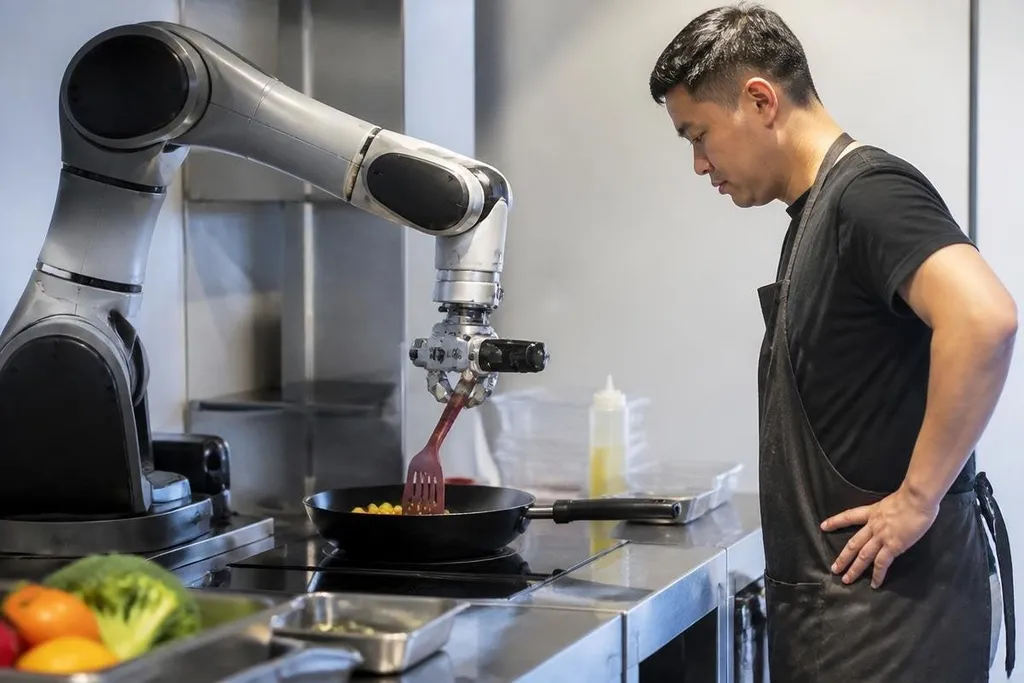
A cooking robot has to find food, move tools, control heat, and recover when an ingredient lands somewhere unexpected. AI can help with those tasks, but it doesn't remove the need for careful hardware, clear recipes, and safe limits.
For a home cook or restaurant operator, the useful question is where AI changes the work and where it still leaves the hard parts to people.
- Vision: identifies ingredients, pans, tools, and their position
- Motion planning: turns a recipe step into arm movement
- Feedback: checks force, temperature, and results during cooking
How AI reads a kitchen
A cooking robot starts with cameras and other sensors. Computer vision software can sort the objects in view by shape, color, and position. That helps the robot tell a bowl from a pan, or a utensil from an ingredient.
The robot still needs a clear way to act on that information. A recipe may say “stir until smooth,” while the control system needs a path for the arm, a speed for the tool, and a limit for contact with the bowl.
That gap is where AI matters. A model can connect a spoken or written instruction with a sequence of smaller actions. The system may split one recipe step into reaching, gripping, pouring, stirring, and checking the result.
The quality of that result depends on the data used to build the system.
A robot trained on clean images and fixed kitchen layouts may struggle when a pan is partly covered, a packet is crumpled, or a tool sits at an odd angle.
Why cooking is hard for robots
Cooking changes as it happens. Dough becomes softer, sauce thickens, vegetables shift in a pan, and steam can block a camera. The robot has to react to those changes instead of repeating one fixed movement.
Force sensing helps with contact. A gripper can detect pressure as it holds an object, while a tool at the end of the arm can detect resistance during stirring or cutting. Temperature sensors add another input, but sensing heat does not by itself decide when food is ready.
Food safety adds another limit. A system must keep raw ingredients away from cooked food, handle hot surfaces, and stop when a person enters its working area. Those rules need clear software checks and hardware controls, not a guess from an AI model.
This is why a cooking robot needs a narrow job before it needs a broad set of skills. Repeating one meal in a fixed kitchen is easier to check than preparing any meal from an open-ended request.
What AI can change for operators
In a restaurant, software could help a robot adjust its actions for different portions or ingredient sizes. It could also record where a task failed, then help an engineer change the recipe steps or robot path.
For a home user, the useful gain may be control through ordinary language. You could state a meal and receive a sequence of actions, but the system would still need to check which ingredients and tools are present before it starts.
Cooking robots sit where software decisions meet heat, liquids, sharp tools, and food handling. AI cooking robot reports from Robot24.com can tie a claim to the named robot, task, test setting, and date before the next section checks what happens when kitchen conditions change.
The open problem is reliability. A robot can finish a task during a planned demo and still fail when the lighting changes, the ingredient package is different, or a person moves a bowl during the recipe.
What remains unproven
A product claim about AI cooking should answer three practical points: what the robot can cook, how much supervision it needs, and what happens after an error. Without those details, “AI-powered cooking” says little about the work you can hand over.
I'd wait before buying a general-purpose cooking robot unless the maker shows repeated tasks in a real kitchen, with clear safety stops and a stated price.
Use this check before you compare products:
- Ask for the task list. Check the meals and kitchen actions the robot has actually shown.
- Check human input. Find out who loads ingredients, moves cookware, and handles cleaning.
- Read the safety plan. Look for stop controls, hot-surface limits, and rules for people near the arm.
- Test the failure case. Ask what happens when an object is missing or the robot loses its grip.
- Price the full setup. Include the robot, tools, sensors, installation, and service.
AI may make cooking robots better at seeing, planning, and adjusting their movements. The next useful proof is not a smoother recipe demo; it is a robot that can repeat the same meal safely after the kitchen stops behaving exactly as planned.